

Manufacturing in Malaysia is becoming increasingly competitive, with factories under pressure to improve production speed, reduce operating costs, and deliver higher-quality products. Traditional cutting methods such as plasma cutting and CO₂ laser systems are slowly being replaced by more advanced and efficient technologies. As part of the growth of CNC machinery Malaysia, more factories are upgrading to smarter and more automated production solutions.
One of the biggest upgrades in modern metal fabrication is the fiber laser cutting machine, which is rapidly becoming the preferred solution for manufacturers in 2026.
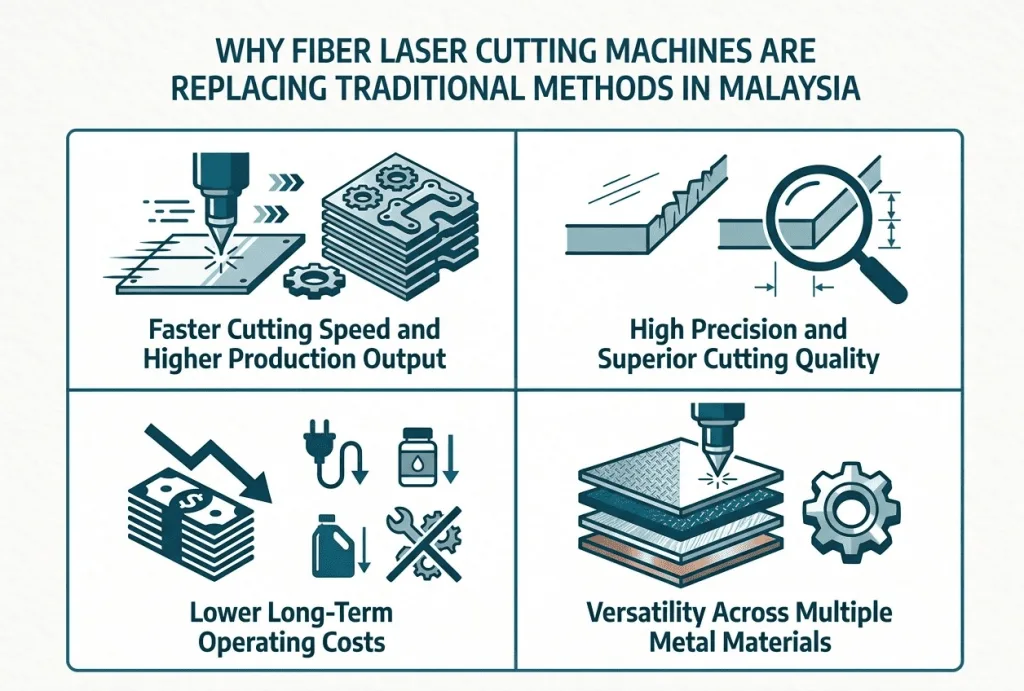
Why Fiber Laser Cutting Machines Are Replacing Traditional Methods in Malaysia
Faster Cutting Speed and Higher Production Output
Fiber laser cutting machines are significantly faster than traditional cutting systems, especially when processing thin to medium-thickness metal sheets. This allows manufacturers to complete more jobs in less time and improve overall productivity.
With higher cutting speeds, factories can:
- Increase daily output
- Reduce production bottlenecks
- Handle larger order volumes efficiently
This is especially important for Malaysian manufacturers competing in fast-paced industries.
High Precision and Superior Cutting Quality
One of the key advantages of fiber laser technology is its ability to produce highly accurate and clean cuts. The laser beam delivers precise results with minimal burrs and heat distortion.
This leads to:
- Better fitting parts during assembly
- Reduced material waste
- Less need for secondary finishing such as grinding or deburring
As a result, production becomes more efficient and consistent.
Lower Long-Term Operating Costs
Although fiber laser cutting machines require a higher initial investment, they offer strong cost savings over time.
Key advantages include:
- Lower electricity consumption compared to older systems
- Reduced use of consumables
- Minimal maintenance requirements
These factors make fiber laser machines a cost-effective long-term investment for manufacturers.
Versatility Across Multiple Metal Materials
Fiber laser cutting machines are capable of processing a wide range of metals, including stainless steel, carbon steel, aluminium, and copper.
This versatility allows factories to:
- Handle different types of production jobs
- Reduce dependency on multiple machines
- Improve workshop flexibility and efficiency
Fiber Laser Cutting vs Traditional Cutting Methods
| Feature | Fiber Laser Cutting | Plasma Cutting | CO₂ Laser Cutting |
|---|---|---|---|
| Cutting Speed | Very high (especially thin metals) | Medium | High |
| Precision | Very high | Moderate | High |
| Edge Quality | Clean and smooth | Rough edges | Good |
| Operating Cost | Low long-term | Medium | Higher |
| Maintenance | Low | Medium | High |
| Material Range | Wide range of metals | Mostly metals | Metals + limited non-metals |
This comparison clearly shows why fiber laser cutting machines are becoming the preferred choice for modern manufacturing in Malaysia.
How Fiber Laser Technology Supports Modern Manufacturing
Integration with Automation Systems
Modern fiber laser cutting machines can be integrated with CNC systems, automated loading and unloading units, and production monitoring software.
This helps factories move towards Industry 4.0 by:
- Reducing manual labour dependency
- Improving production accuracy
- Increasing workflow efficiency
Reduced Post-Processing Requirements
Because fiber laser cutting produces clean and precise edges, there is significantly less need for additional finishing work such as grinding, polishing, or deburring.
This results in:
- Faster production cycles
- Lower labour costs
- More streamlined operations
Industry Demand in Malaysia
The demand for fiber laser cutting machines is growing across multiple industries in Malaysia, including:
- Metal fabrication
- Automotive manufacturing
- Electrical and electronics
- Construction and engineering
As competition increases, manufacturers are upgrading their equipment to meet higher standards of speed, quality, and efficiency.
Conclusion
The shift toward fiber laser cutting machines in Malaysia is driven by the need for faster production, higher precision, and lower operating costs. Within the broader CNC machinery Malaysia market, fiber laser technology is becoming a key driver of industrial modernization.
Manufacturers that adopt this technology early are positioning themselves for stronger efficiency, better quality output, and long-term competitiveness.
Frequently Asked Questions (FAQs)
What is a fiber laser cutting machine used for?
It is used for cutting metal materials such as stainless steel, carbon steel, aluminium, and copper with high speed and precision.
Why are fiber laser cutting machines better than traditional cutting methods?
They offer faster cutting speed, higher precision, cleaner edges, and lower long-term operating costs compared to plasma or CO₂ laser systems.
Can fiber laser cutting machines cut thick metal sheets?
Yes, depending on the machine power, they can cut both thin and thicker metal sheets, with higher wattage machines handling thicker materials more effectively.
Do fiber laser cutting machines require a lot of maintenance?
No, they generally require less maintenance than traditional systems, mainly routine checks on optics, consumables, and cleaning.
Is fiber laser cutting suitable for small and medium factories in Malaysia?
Yes, it is suitable for both SMEs and large factories because it improves efficiency, reduces labour work, and supports scalable production.